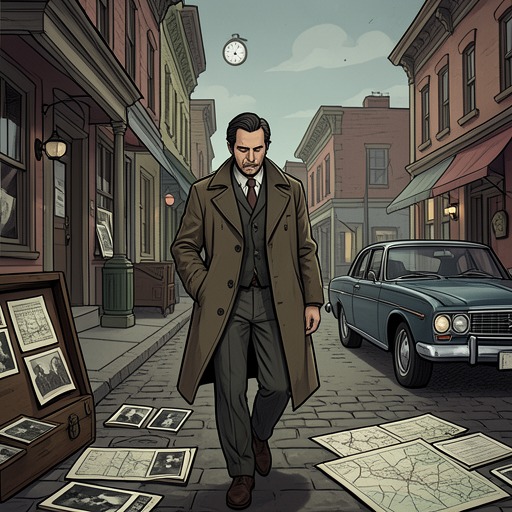
To go forward, I have to go back
The Guilty“To go forward, I have to go back” names the paradox at the center of Will Robie’s return: the future he had built on the East Coast cannot be separated from the past he left behind. The phrase becomes his rationale for confronting that past when his father, Daniel Robie, is charged with murder and his own work reaches an impasse.
Context
After arriving on the East Coast, Will had hoped to begin a new life with Laura Barksdale, but that future did not materialize. He arrived alone, confused, and angry. A confluence of events had saved his life and future and set him on the path toward his career, but its secrecy kept him from contacting his father or considering a return to his old home.
Meaning and Function
The expression turns backward movement into a condition of forward progress. Will does not describe returning as a retreat or a completed solution; his wording presents it as the necessary next step. The need arises from two pressures at once: his father’s murder charge makes the family past immediate, while Will’s inability to complete his last assignment shows that the life he has built is no longer proceeding as before.
The Return as a Turning Point
Will says his finger could not pull the trigger, then clarifies that the little girl’s face was not what held him back. The passage establishes the failure without explaining its cause, preserving a consequential uncertainty even as it makes clear that the problem reaches beyond the apparent circumstance. Against that unresolved professional crisis, his father’s arrest becomes a catalyst for facing what he had left unaddressed.
The thought is followed by the decision’s plain consequence: “And so here I am.” The phrase therefore functions both as self-explanation and as a threshold into the return. It does not promise that going back will resolve the past; it defines the confrontation as necessary before Will can move forward.